
近垂直ロータ
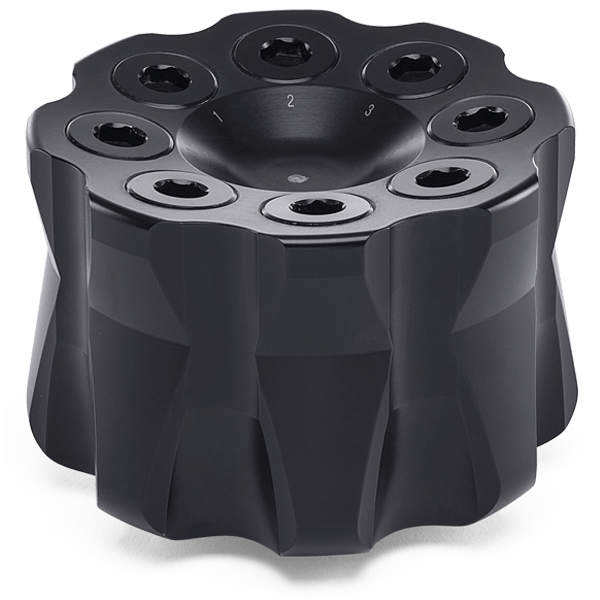
近垂直ロータは、沈降経路長と遠心時間が短く、優れた分解能が特徴です。
近垂直ロータのチューブは、垂直から7.5~9°の角度になっています。 これにより、沈降経路長が短くなります。 沈降経路長が短いということは、遠心時間が短くなることを意味します。 わずかに角度があることでチューブの底側面にペレットを形成するため、遠心を停止したときにコンタミを起こしづらくなります。
近垂直ロータの使用目的と仕組みの詳細はこちら




FAQ on Near-Vertical Rotors
What is the difference between a near-vertical rotor and a fixed-angle rotor?
A fixed-angle rotor is typically optimized for rapid pelleting applications, while a near-vertical rotor is often chosen for density gradient and isopycnic centrifugation workflows. Near-vertical rotors provide a shorter path length within the gradient, which can help reduce separation times for equilibrium and gradient-based applications.
Why are near-vertical rotors used for density gradient centrifugation?
Near-vertical rotors provide a shorter sedimentation path than many other rotor designs. This can reduce run times and support efficient density gradient separations while maintaining resolution between particles with different buoyant densities.
Why choose a near-vertical rotor for DNA purification?
Near-vertical rotors are commonly used in density gradient-based nucleic acid separation workflows because they can support efficient migration of DNA molecules through the gradient while reducing run times compared with some traditional rotor configurations.
What is a near-vertical rotor?
A near-vertical rotor is an ultracentrifuge rotor that holds sample tubes at a shallow angle between vertical and fixed-angle orientations. This geometry creates a shorter sedimentation path, helping reduce centrifugation times while maintaining high separation efficiency.
What applications are near-vertical rotors commonly used for?
Near-vertical rotors are frequently used for density gradient centrifugation, isopycnic separations, DNA purification, viral particle isolation, lipoprotein analysis, and other high-resolution ultracentrifugation workflows.
What is isopycnic centrifugation?
Isopycnic centrifugation is a density gradient separation technique in which particles migrate until they reach a position where their density matches the density of the surrounding gradient medium. Near-vertical rotors are commonly used for these applications because they can support efficient equilibrium separations.
